
Voucher Cloud & Cybersecurity
The MIMIT Cloud & Cybersecurity Voucher offers small and medium-sized enterprises (SMEs) and self-employed individuals a concrete opportunity to invest in the security and evolution of their IT infrastructure.

Oplon Secure Access 13.0.0 is out Update →
With release 13.0.0, Oplon Secure Access negotiates a post-quantum hybrid key exchange by default on all TLS 1.3 connections it terminates or initiates. Encrypted traffic today remains protected even against a future adversary equipped with a quantum computer, without requiring any configuration changes and without losing compatibility with existing clients.
The threat is neither theoretical nor distant. In the “harvest now, decrypt later” scenario, an attacker records encrypted traffic today and stores it, waiting to decrypt it once they have a sufficiently powerful quantum computer. For those who manage identities, credentials, and sessions for government agencies, banks, and healthcare organizations, data in transit often holds value that lasts well beyond the time it would take to build a sufficiently powerful quantum computer.
In TLS 1.3, the confidentiality of a session depends entirely on the ephemeral key exchange (ECDHE, typically using X25519 or P-256). The client and server derive a shared secret from which the symmetric keys used to encrypt all traffic are generated.
Shor’s algorithm, when run on a cryptographically relevant quantum computer, solves the discrete logarithm problem on elliptic curves in polynomial time. Anyone who has recorded the handshake can therefore reconstruct the shared secret and decrypt the entire session retroactively.
Symmetric encryption (AES-256-GCM, ChaCha20-Poly1305), on the other hand, remains robust: Grover’s algorithm at most halves its effective security margin. The risk that must be mitigated immediately is therefore the key exchange, not the encryption of the data.
Our implementation is based on ML-KEM (Module-Lattice-Based Key-Encapsulation Mechanism), standardized by NIST in 2024 as FIPS 203. Its security is based on the Module Learning With Errors problem, for which no efficient quantum algorithms are known.
ML-KEM is an encapsulation mechanism, not a Diffie-Hellman exchange. The client generates a key pair and sends the public key; the server encapsulates a random secret within it and returns the ciphertext; the client decapsulates it and obtains the same secret.
Parametro
Livello NIST
Chiave pubblica
Ciphertext
ML-KEM-768
3
1.184 byte
1.088 byte
ML-KEM-1024
5
1.568 byte
1.568 byte
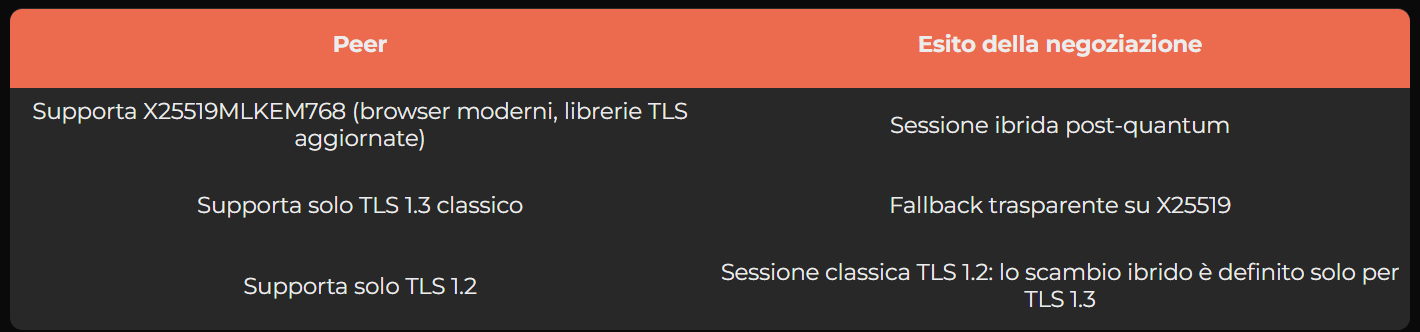
No existing client stops working: the hybrid group is only the first in the preference list, not the only one. The result depends on the peer:
Peer
Esito della negoziazione
Supporta X25519MLKEM768 (browser moderni, librerie TLS aggiornate)
Sessione ibrida post-quantum
Supporta solo TLS 1.3 classico
Fallback trasparente su X25519
Supporta solo TLS 1.2
Sessione classica TLS 1.2: lo scambio ibrido è definito solo per TLS 1.3
The overhead is minimal: about 1.1 KB more per direction during the handshake and a computational cost for ML-KEM comparable to that of X25519. There is no impact on already established sessions, because the symmetric encryption remains unchanged.
A note for those with intermediate devices: the protection applies to the segment where Oplon terminates TLS. If there is a load balancer, WAF, or proxy in front of the Oplon nodes that terminates the connection, that device determines the key exchange with the client. Furthermore, some older middleboxes do not handle ClientHello messages larger than a single packet properly.
To enable protection, simply update the nodes to release 13.0.0: hybrid support is enabled by default. To verify this and get the most out of it:
With Oplon, it’s easy to verify which cryptographic algorithms your infrastructure actually uses. For each connection, Oplon logs the protocol version and the key exchange algorithm negotiated by the client and server during the handshake, on both the client side and the backend side.
This data immediately reveals which applications still use outdated protocols or algorithms, such as TLS 1.0, 1.1, or 1.2, or rely solely on a classic key exchange. This allows for targeted planning of updates: at least to TLS 1.3 as a first step, or directly to post-quantum hybrid key exchange. The same data feeds the cryptographic inventory with evidence collected from real-world traffic.
This last point is no minor detail. The EU’s coordinated roadmap for the transition to post-quantum cryptography, developed by the NIS Cooperation Group, calls for cryptographic inventories and transition plans by the end of 2026 and the migration of high-risk use cases by 2030, including healthcare and finance. For those operating under NIS2 and ISO/IEC 27001:2022, adopting hybrid key exchange today is a concrete and documentable step in that direction.
Oplon Secure Access 13 makes the key exchange for every TLS 1.3 connection it manages post-quantum by default, without sacrificing compatibility. This is the first step on a path that will follow industry standards as they evolve, starting with digital signatures.
For more information, please fill out the form in the Contact section.

The MIMIT Cloud & Cybersecurity Voucher offers small and medium-sized enterprises (SMEs) and self-employed individuals a concrete opportunity to invest in the security and evolution of their IT infrastructure.


Oplon Secure Access 12.3.0 introduces enhancements designed to make remote access management even more efficient, secure, and simple. The new release offers improved Remote Desktop session quality thanks to Sharp Mode, more advanced password rotation control with the new Password Rotation Test Runner, and the ability to create Temporary Connections

The MIMIT Cloud & Cybersecurity Voucher offers small and medium-sized enterprises (SMEs) and self-employed individuals a concrete opportunity to invest in the security and evolution of their IT infrastructure.
Oplon Secure Access 12.3.0 introduces enhancements designed to make remote access management even more efficient, secure, and simple. The new release offers improved Remote Desktop session quality thanks to Sharp Mode, more advanced password rotation control with the new Password Rotation Test Runner, and the ability to create Temporary Connections

Click Days are no longer about attacks, but synchronized legitimate demand that can collapse systems. Traditional WAFs fail: they protect the network, not backend capacity. Resilience requires managing real application capacity under extreme load.
Compila il form per ricevere una mail contenente il link che ti permetterà di scaricare il Partner Program in formato PDF.